
A Christmas Story (1983) occupies a strange and enviable place in American popular culture. It was a modest holiday release from director Bob Clark, adapted loosely from the semi-autobiographical writings and radio monologues of humorist Jean Shepherd, and it earned only lukewarm numbers during its initial theatrical run. Decades of basic-cable marathons later, it is difficult to find an American household that doesn't recognize the leg lamp, the Red Ryder BB gun, the tongue frozen to a flagpole, or the immortal warning that any given object "will shoot your eye out." The film's structure leans heavily on the interior life of its nine-year-old narrator, Ralphie Parker, whose daydreams punctuate the otherwise gentle, episodic story of a Depression-era Indiana family preparing for Christmas. Ralphie imagines himself as a gunslinging hero saving his family from bandits, as a martyr blinded by soap poisoning, as a straight-A genius whose teacher swoons over his prose. These fantasy sequences are part of what gives the film its comic rhythm — reality repeatedly interrupted by a small boy's grandiose interior mythology.
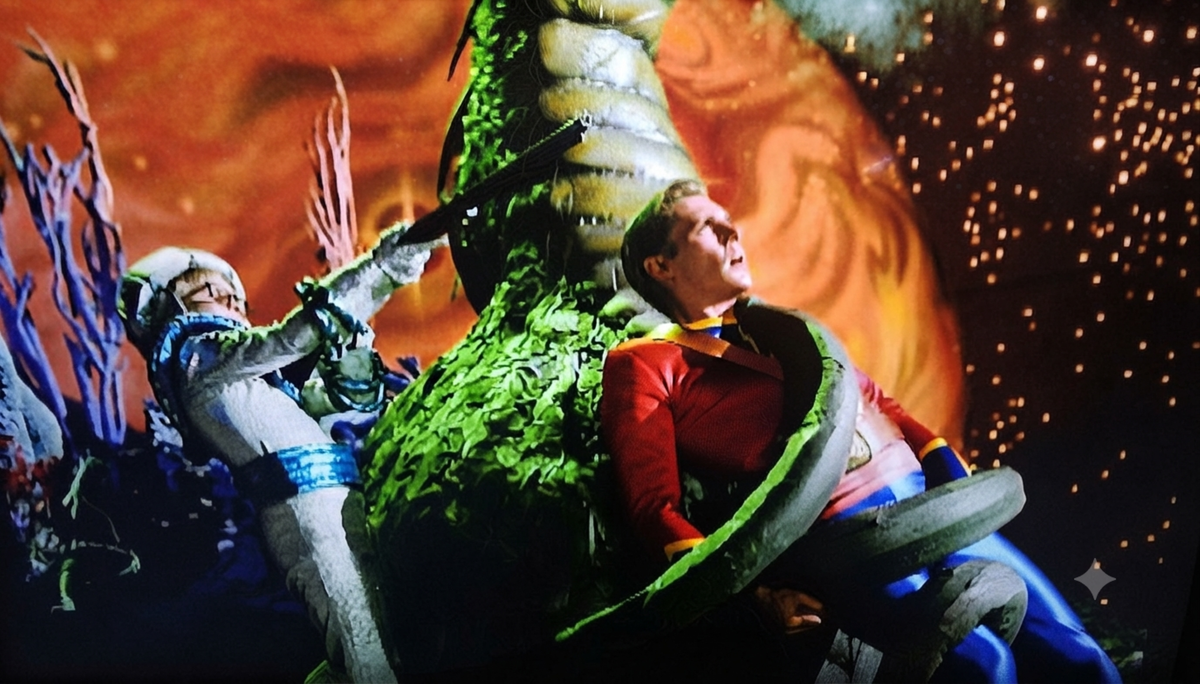
But one of these fantasies never made it to audiences. Buried in the film's production history, referenced obliquely in its own closing credits, and kept alive largely through fan curiosity and a handful of interviews, is a sequence in which Ralphie dons a spacesuit, wields his beloved Red Ryder rifle, and rescues the pulp science-fiction hero Flash Gordon from the clutches of the villain Ming the Merciless. It was fully written, cast, costumed, built, shot, and scored — and then, before the film reached its final cut, removed entirely. Today, no footage of the sequence is known to survive. What remains is a strange archival residue: a name in the credits with no corresponding scene, photographs of costumes in a small Ohio museum, a surviving script, and the recollections of the people who made it. This essay examines what is known about the "missing" Flash Gordon sequence — what it depicted, why it was cut, what evidence of it endures, and what its disappearance says about the nature of film preservation, the editorial instincts of Bob Clark, and the peculiar afterlife of A Christmas Story itself.
The Structure of Ralphie's Imagination
To understand why the Flash Gordon sequence existed — and why it was ultimately excised — it helps to look at how fantasy operates elsewhere in the finished film. A Christmas Story is narrated in retrospect by an adult Ralphie (voiced by Shepherd himself), whose wry, nostalgic commentary frames every scene. The daydream sequences are visual punctuation marks dropped into this narration: brief, theatrical, and exaggerated departures from the otherwise mundane texture of small-town Indiana life. When Ralphie worries that his B-plus theme on the Red Ryder gun will disappoint his teacher, the film cuts to a fantasy in which the entire class, and Miss Shields herself, erupt into worshipful admiration of his genius, awarding him an impossibly high grade written across an entire chalkboard. When Ralphie imagines the catastrophic consequences of accidentally shooting his eye out, the film shows him, one moment later, arriving home blind, tapping a white cane, to the horror and grief-stricken remorse of his parents. Earlier still, walking home from school, Ralphie pictures himself gunning down outlaws — including the film's recurring fantasy villain "Black Bart" — with a coolness undercut by the incongruity of a child in short pants performing an Old West shootout.
These sequences share a few consistent features. They are short. They are self-contained, requiring no world-building beyond what the audience already understands about cowboy movies, schoolroom melodrama, or B-movie disaster. And critically, they are contained within Ralphie's ordinary, recognizable world — his classroom, his living room, his neighborhood sidewalk. The comedy depends on the gap between the mundane real world and the operatic scale of a boy's imagination, but that gap is legible precisely because the fantasy costume never fully replaces the everyday setting; Miss Shields is still recognizably Miss Shields even while dressed as a fairy-tale figure bestowing praise.
The planned Flash Gordon sequence broke from this pattern in a fundamental way. Rather than restaging an environment the audience already knew — reimagining Ralphie's living room as a saloon, or his classroom as a coronation hall — it proposed to transport Ralphie into someone else's fully realized universe: the pulp science-fiction cosmos of Alex Raymond's Flash Gordon, a comic-strip mythology Ralphie is shown reading in his bedroom elsewhere in the film. Instead of a costume and blocking change within a familiar set, the sequence called for its own alien planet, complete with elaborate rock formations, tree-branches built and rigged to resemble serpents, and hand-operated creature effects. It was, in other words, an entirely different scale of production embedded inside a small, intimate coming-of-age comedy.
What the Sequence Depicted
According to accounts from cast members involved in the production, the deleted sequence dramatized Ralphie's fantasy of rescuing the science-fiction hero Flash Gordon from the villain Ming the Merciless. In the scene as described, Ming the Merciless pins Flash Gordon down in outer space and threatens to destroy the Earth, and Ralphie appears in a space suit at the pivotal moment to save the superhero with his Red Ryder rifle. Ralphie's arrival, in other words, mirrors the rescue logic of the film's other daydreams — the boy and his prized BB gun single-handedly resolving a crisis that adults or larger heroic figures cannot — but staged with the visual vocabulary of Flash Gordon serials rather than a Western.
Peter Billingsley, who played Ralphie, later described the physical scale of the shoot in an interview promoting a 2022 documentary podcast about the film. Speaking decades after production, Billingsley recalled that the sequence was filmed in Toronto on an elaborate "space rock" set, with Flash Gordon pinned down by his nemesis before Ralphie arrives in a spacesuit to rescue the hero with his Red Ryder rifle. Billingsley also remembered his own self-consciousness at the time, noting that he felt awkward filming in the all-blue costume required for the scene.
The Canadian actor who played Flash Gordon in the sequence, Paul Hubbard, gave a more granular account of the physical production in an interview years later. Hubbard recalled that the producers spared no expense on the set, which included hand-operated creature effects and was, in his words, fairly complicated to build. He also described being bound during the scene by tree branches constructed and shaped to resemble snakes — set dressing built specifically to visualize the alien, hostile terrain of Flash Gordon's world. Hubbard, notably, said he had not seen the finished footage since the initial cast screening Bob Clark held before the film's release, and that he was startled to later learn the sequence had been removed entirely.
Taken together, these firsthand accounts sketch a scene considerably more ambitious in scope than anything that survived into the released picture: a fully built extraterrestrial set, practical creature effects, a villain and hero played by adult actors in costume, and a production budget allocated to a single fantasy sequence that could easily rival the resources spent on entire other scenes in the modestly budgeted film.
Why the Scene Was Cut
The likeliest explanation for the sequence's removal, based on the available record, is not that it failed technically but that it broke the tonal contract the rest of the film had established with its audience — and that this became apparent only once the footage was tested in front of viewers. Billingsley's recollection of Bob Clark's reasoning is the most direct evidence available. According to Billingsley, Clark ultimately felt this particular fantasy "crossed the line," and concluded that keeping Ralphie's daydreams contained within his own recognizable world was what made the device work. A companion piece covering the same interview adds that test audience reaction was a significant factor in the decision to remove the scene, with the material seemingly clashing against the aesthetic of the rest of the picture.
This account fits neatly with the structural analysis above. Every other fantasy in A Christmas Story is legible instantly, in a single visual beat, because it recontextualizes something the audience has already seen — a classroom, a living room, a sidewalk — rather than asking them to accept a wholly new setting, cast of characters, and genre. A Western shootout fantasy works because the audience doesn't need Black Bart explained to them at length; the iconography of a cowboy villain is culturally legible in an instant, and the joke is purely about the incongruity of a boy performing it. Flash Gordon and Ming the Merciless, however, required the audience to accept an entirely separate fictional mythology, with its own hero, villain, planet, and stakes, dropped into the middle of an otherwise grounded film about a family trying to get through the holidays. Where the other fantasies are a costume change, the Flash Gordon sequence was closer to a film-within-a-film. It's plausible that in a rough cut, surrounded by scenes of Ralphie's mother making meatloaf and his father wrestling with a furnace, an extended science-fiction rescue sequence with alien creature effects simply overwhelmed the modest, warmly observational comic tone that defines the picture's identity.
There is also a pacing argument implicit in the surviving structure of the film. A Christmas Story is a lean 93 minutes, built from a series of vignettes that rarely overstay their welcome; even its longest comic set pieces, like the visit to the department store Santa or the family's disastrous restaurant Christmas dinner, resolve quickly. A fully realized science-fiction rescue, with its own set, its own villain, its own resolution, would likely have run considerably longer than any of the other daydream sequences, disrupting the film's brisk episodic rhythm. Cutting it in favor of the shorter, sharper fantasies that made the final print preserved that rhythm.
Here's What We Know
What makes the Flash Gordon sequence unusual, compared to ordinary deleted scenes, is how much indirect evidence of its existence survives even though the footage itself apparently does not. The clearest trace is hiding in plain sight: the closing credits of the released film. Actor Paul Hubbard is credited as "Flash Gordon," with a notation indicating the scene was deleted — a credit that has puzzled and delighted attentive viewers for decades, since the character never appears in the finished cut. The theatrical and home video credits list "Flash Gordon" among the cast, followed by the notation "(scenes deleted)." This detail alone has become one of the film's most repeated pieces of trivia, cited by entertainment outlets and fan communities as proof that a much larger fantasy sequence once existed.
Beyond the credits, physical artifacts from the production survive in a dedicated museum. The A Christmas Story House and Museum in Cleveland, Ohio — built around the house used for the Parker family's exteriors — maintains a collection of props, costumes, and photographs from the production, including material specifically from the deleted sequence. The museum displays photographs and costume pieces from the deleted Flash Gordon scene. This is corroborated by other summaries of the film's production history, which describe surviving costumes, sketches, and photographs from the sequence on display at the museum, along with scripts for the deleted scenes.
The script itself is also reported to survive in some form, distinct from the footage. Descriptions of the scene's plot and dialogue circulating among fans are apparently sourced from these surviving pages rather than from the footage, which several of the film's own participants say no longer exists in any viewable form.
The Script Pages For The Missing Flash Gordon Sequence
Here is the transcript of the dialogue and narrative sequence from the infamous, fully-budgeted and filmed Flash Gordon dream sequence that was ultimately cut from the theatrical release of A Christmas Story due to runtime constraints.
This sequence directly follows Ralphie's daydream about Miss Shields and his parents reading his persuasive essay.
INT. RALPHIE'S BEDROOM - DAY
Ralphie is lost in his reverie. He smiles vacantly, gets up, wanders aimlessly across the room, and flops down on his bed amid a pile of comic books. He stares at the ceiling.
NARRATOR:
Captain Ahab and his crazy thing about that white whale had nothing on me. I wanted that BB gun so bad it was making my stomach hurt.
Ralph groans.
RALPHIE:
Ohhh—
He flops over on his stomach and flings one of his comic books at the wall next to him. He stares at it blankly. Its lurid cover reads: FURTHER ADVENTURES OF FLASH GORDON ON THE PLANET MONGO. The cover shows a scene of Flash Gordon, his golden hair gleaming, facing his evil arch-enemy Ming the Merciless. Ralph stares at the cover blankly for a few moments.
EXT. PLANET MONGO
The scene dissolves, and we are in what appears to be the futuristic, dank atmosphere of an alien planet. Ming the Merciless fills the screen. He appears eighteen feet tall, dressed in jade-green robes with sinister gold cabalistic symbols flashing in the unnatural light, his eyes glittering with evil, his Fu Manchu mustache adding to the horror, his yellow parchment skin ageless.
MING:
At last, Flash Gordon, I have you at my mercy!
He cackles with fiendish laughter.
Camera pulls back, and we see Flash tied with huge ropes, hand and foot, to a strangely sinister tree trunk that appears to have snakeskin instead of bark.
Ming snaps his golden bullwhip in the air viciously. Behind him, we see the woven basket of a curiously futuristic balloon. The balloon has sulphureous, lidded cat's eyes painted on it.
MING:
There is no hope for you, Flash Gordon. I will now proceed to destroy the planet Earth with my Turbo-Xenon Space Balloon, with its deadly Z-Gamma Rays!
FLASH:
Ming, we Earthlings will live forever. You—
Ming snaps his whip imperiously.
MING:
In moments, that Cobra Tree will awaken and devour you!
There is a quick cut, and we see, in the dank jungle undergrowth, Ralphie's eyes peering out at this awful pageant. His eyes are wide with wonder, yet there is grim determination.
RALPHIE (O.S.):
Take that, Ming the Merciless!
A projectile streaks upward.
We hear Ming's screaming shriek.
MING:
Oh no, NO!
His balloon makes an obscene farting noise, careening off crazily, growing smaller and smaller by the instant.
FLASH (his voice quivering with reverent emotion):
It's the end of Ming the Merciless. You have done it, Ralph. You have saved all Earthlings. You have saved our planet!
The Flash Gordon Sequence Script Pages


Is the Flash Gordon Sequence Actually Lost Or Is It Just In A Vault Wasting Away Somewhere?
Here the record becomes genuinely uncertain, and this uncertainty is itself part of what makes the sequence such a durable subject of fan fascination. Two contradictory accounts exist regarding what happened to the physical film elements after the sequence was cut, and both come from people who worked directly on the production.
Peter Billingsley's account is the more pessimistic of the two. He has stated in interviews that the loss of the scene is especially frustrating because it predates the DVD era, and that, as he understood it, the negatives were simply thrown out during the editing process. In a separate account of the same interview, this claim is summarized even more starkly, with Billingsley reportedly confirming that the Flash Gordon footage is "gone forever."
Editor Stan Cole, however, has offered a different version of events. According to the same secondary summary, Cole has said that the deleted material was sent back to the studio along with all of the other footage once the film was completed, and was simply never seen again — rather than being destroyed outright. This distinction matters enormously to anyone hoping the sequence might one day resurface. If Billingsley's recollection is correct and the negative was discarded during editing, the footage is almost certainly gone for good. If Cole's account is correct, the material may simply be misplaced in a studio archive somewhere, uncatalogued and unrequested for more than forty years — the kind of footage that occasionally does turn up decades later when a studio vault is inventoried or a film is prepared for a restoration.
This ambiguity has made the sequence a recognizable case study within online communities devoted to tracking down "lost media" — footage, recordings, or broadcasts that are known to have existed but are not publicly accessible. Because the Flash Gordon sequence has multiple forms of secondary evidence (credits, costumes, a script, eyewitness accounts from more than one participant) but zero surviving visual footage, it occupies a particular niche: not an urban legend, since its existence is not seriously disputed, but not a preserved deleted scene either, since it has never been included on any home video release, special edition, or archival reissue of the film in more than four decades of A Christmas Story's home media history.
Why Are We Fascinated About The Sequence?
It would be easy to treat the vanished Flash Gordon sequence as a piece of minor movie trivia — a fun fact for a quiz night, or a footnote for hardcore fans. But its absence illuminates something more interesting about how A Christmas Story actually works as a film, and about the vulnerability of even beloved, frequently rewatched movies to gaps in the historical record.
First, the missing scene is a useful negative example. Bob Clark's decision to remove it, whether driven by test-audience feedback or his own editorial instinct, effectively defined the tonal boundaries of the finished film by showing what it was not going to be. A Christmas Story survives as a comedy of scale — small daydreams erupting from a small life, a boy's grandiosity measured against the modest reality of 1940s Hoyt Street. Had the Flash Gordon sequence remained, the film's fantasy sequences would have ranged from "class applauds my essay" to "I save a science-fiction hero from an alien tyrant on a distant planet," a tonal range wide enough to potentially unbalance the delicate naturalism that gives the rest of the movie its charm. The cut, in other words, wasn't just a trim for runtime — it preserved the internal logic of the film's comic device.
Second, the sequence is a case study in how incomplete film preservation can be, even for movies that become genuine cultural institutions. A Christmas Story has been rebroadcast, quoted, referenced, and merchandised relentlessly since the 1990s; it has spawned an official sequel, a stage musical, and an entire tourist industry built around its production locations. And yet a substantial, fully cast and costumed sequence from its original shoot has simply disappeared from the historical record, with the only physical remnants being a handful of props and photographs sitting in a small regional museum. If a scene from a film this closely studied, this frequently rewatched, and this thoroughly merchandised can vanish this completely, it says something sobering about the survival odds of footage from far more obscure productions.
Finally, the mystery of the sequence's fate — destroyed negative or misplaced studio reel — keeps the story alive in a way a simple "here's the deleted scene" clip never could. Ambiguity invites continued interest. Fans return to interviews, comb through production photographs, and speculate about studio vaults precisely because the ending of the story is not settled. Every few years, a new interview with a surviving cast member, like Hubbard's, adds another fragment to the record without resolving the central question of whether the footage still physically exists somewhere.
The Truth About The Scene
The Flash Gordon sequence cut from A Christmas Story occupies an unusual space in film history: well-documented enough that its existence is beyond serious doubt, yet visually unrecoverable in any form that has surfaced publicly in over forty years. What remains is a credit with no matching scene, a museum case of costumes and photographs, a script, and the somewhat conflicting memories of the people who built and performed it. Peter Billingsley remembers a discarded negative and a scene gone forever; Stan Cole remembers footage returned to a studio and simply never revisited. Between those two accounts sits the actual, unresolved fate of several minutes of film — an alien rock set, a villain named Ming, a boy in a self-consciously blue spacesuit, and a rescue that generations of holiday viewers have never gotten to see.
What survives instead is the shape of an absence: a title in the closing credits that promises a scene the film never delivers, and a persistent curiosity, renewed with each new interview or museum visit, about whether somewhere in a studio vault, a reel of "Flash Gordon (scenes deleted)" is still quietly waiting to be found.